Bluetooth Speaker Battery Types: A Chemistry Comparison
By Diego Park • 29th May
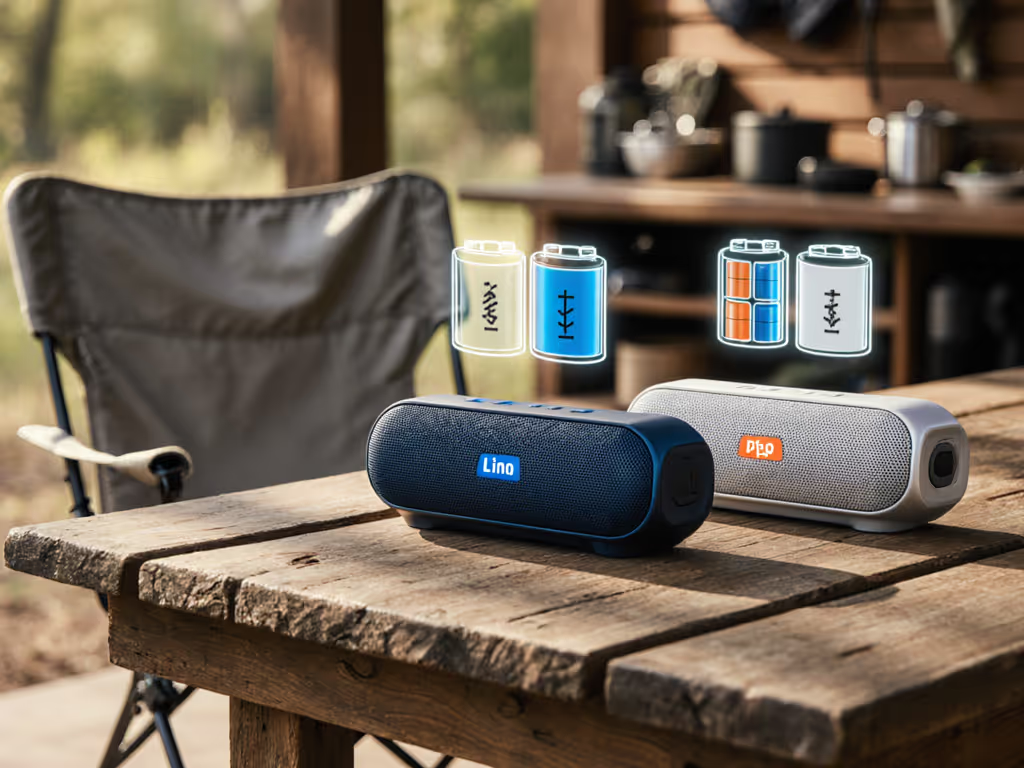
Bluetooth speaker battery types are almost all variants of lithium-based chemistry, but the way those cells are packaged and protected has real consequences for runtime, safety, size, and long-term cost. This battery chemistry comparison will walk you through the trade-offs so you can predict how a speaker will behave in your shower, kitchen, balcony, or campsite (without getting lost in buzzwords).
Why Battery Chemistry Matters More Than Marketing
Most speakers advertise hours of playtime, but very few explain what kind of cells are inside or how those cells age when you crank the volume, leave the speaker in a hot car, or use it every day. For practical ways to extend real runtime, see our battery life field tips.
The chemistry and format of the battery affect:
- Usable runtime at real volumes, not just 30% in a lab.
- How quickly the battery degrades after hundreds of charge cycles.
- Safety margins if it overheats, gets punctured, or is manufactured poorly.
- Repairability and replacement cost if the pack eventually fades.
As someone who once lined up three speakers after a beach mishap and timed them until they died on the same playlist, I learned that what matters is cost per hour of clean, uninterrupted sound, not brand names. Pay for outcomes, not labels.
The Main Bluetooth Speaker Battery Types Today
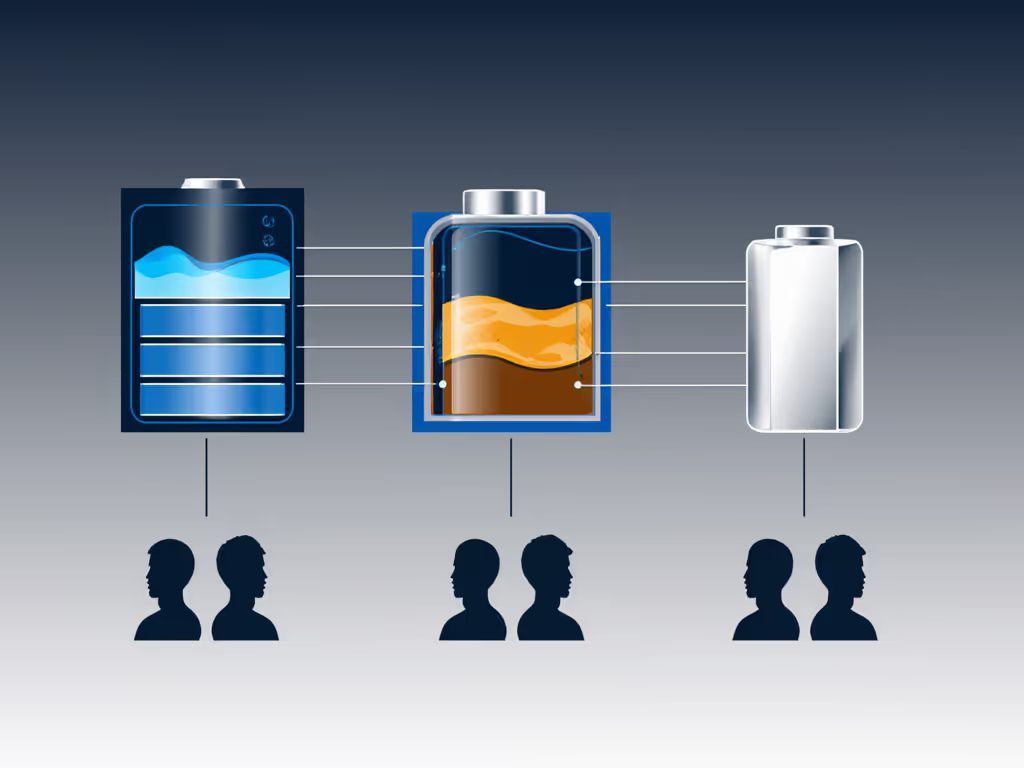
In consumer Bluetooth speakers, you will encounter three practical Bluetooth speaker battery types:
- Conventional lithium-ion (Li-ion): cylindrical or prismatic cells.
- Lithium-polymer (Li-Po): pouch cells.
- Early solid-state variants: mostly emerging and rare in mass-market speakers.
Older chemistries like nickel-metal hydride (NiMH) or lead-acid are now niche in this category; nearly all modern portable speakers rely on lithium for energy density and weight reasons, a point widely echoed by battery manufacturers.[10]
1. Conventional Lithium-Ion (Li-ion)
When a spec sheet just says "lithium-ion battery", it usually means liquid-electrolyte cells in a hard metal can (like the 18650 or 21700 cells used in many tools and laptops) or prismatic cans.
What this chemistry does well
- High energy density for the money: You get a lot of watt-hours per dollar, which is why most value and mid-range speakers use Li-ion.[10]
- Decent cycle life: Typically hundreds of full charge cycles before noticeable loss, assuming moderate temperatures and partial cycles.
- Good performance at moderate temperatures: Cold will still reduce runtime, but less dramatically than some pouch packs. For data on how speakers handle temperature extremes, see our extreme temperature tests.
- Mechanical robustness: Metal cans tolerate handling and mild compression better than soft pouches.
Where Li-ion is weaker
- Less flexible shape: Cells are rigid cylinders or blocks, so designers sometimes sacrifice internal space efficiency or aesthetics.
- Thermal runaway risk if abused: Like any lithium cell, severe overcharge, physical damage, or internal defects can cause venting or fire; this is managed via protection circuits and safety standards.[10]
In practice, Li-ion is the workhorse for medium and larger speakers where a slightly thicker body is acceptable in exchange for lower cost per hour of playback.
2. Lithium-Polymer (Li-Po, Pouch Cells)
When marketing calls out "lithium-polymer" or emphasizes ultra-slim design, the speaker likely uses pouch cells. Technically, Li-Po is still a lithium-ion chemistry, but with a polymer-based electrolyte and a flexible foil pouch instead of a metal can.
What Li-Po does well
- Shape flexibility: Pouches can be thin and wide, letting designers build flatter speakers or tuck cells into odd spaces.
- High volumetric energy density: You can sometimes squeeze slightly more capacity into the same volume compared with rigid cells.
- Lightweight: Less metal casing can reduce weight.
Where Li-Po is weaker
- Swelling and mechanical vulnerability: Pouches can puff up if overcharged, overheated, or aged poorly. Once they swell, replacement is usually the only safe option.
- More glue, less repairability: To keep a thin profile, manufacturers often glue pouches to the housing. That looks clean but makes battery replacement harder and riskier.
- Costs slightly more per Wh: You may pay a quiet premium for the slim form factor.
Li-Po is common in small, thin, or design-driven speakers that prioritize pocketability or wall-hugging profiles over rugged, user-serviceable packs.
3. Solid-State Speaker Batteries (Early Stage)
You'll see increasing talk about solid-state speaker batteries, usually in press releases rather than spec sheets.
Solid-state cells replace the flammable liquid electrolyte with a solid material, aiming for:
- Higher energy density: more runtime in the same or smaller space.
- Lower fire risk: solid electrolytes are less prone to leakage and thermal runaway.
- Better high-temperature stability.
Right now, these cells are rare in mainstream Bluetooth speakers. Expect them first in:
- High-end compact devices where every cubic millimeter counts.
- Future rugged speakers where improved safety and puncture resistance are selling points.
From a buyer's perspective in 2026, solid-state is more of a future-proofing headline than a deciding factor. If you see the term, treat it as a bonus, not a must-have.
4. Legacy Chemistries (Increasingly Rare)
A few edge cases:
- NiMH: Found in older or ultra-budget designs. Lower energy density, heavier, but tolerant of abuse. Almost obsolete in modern Bluetooth speakers.[10]
- Lead-acid: Only relevant to large, wheeled party systems or DIY setups. Very heavy and not suitable for daily carry.
For typical shower, kitchen, or patio speakers, you can safely assume lithium-based cells unless the product explicitly says otherwise.[10]
Lithium-Ion vs Lithium-Polymer: A Practical Battery Chemistry Comparison
Here is how lithium-ion vs lithium-polymer shakes out in real speaker use:
| Factor | Conventional Li-ion (cylindrical/prismatic) | Li-Po (pouch) |
|---|---|---|
| Cost per Wh | Usually lower; good for value builds | Usually higher; you pay for thinness |
| Shape flexibility | Limited; dictates thicker designs | High; enables slim or unusual shapes |
| Durability | Rigid cans resist compression better | Pouch more vulnerable to puncture and bending |
| Cycle life | Solid if well-managed; hundreds of cycles | Similar on paper, but more sensitive to heat and abuse |
| Repairability | Easier to replace discrete cells in some designs | Often glued; harder and riskier to service |
| Use cases | Rugged, jobsite, larger party speakers | Slim travel, wall-mounted, or style-first speakers |
For value-focused buyers, Li-ion designs usually offer a better cost-per-hour of playback over the life of the speaker, especially when you factor in simpler battery replacement paths.
Battery Safety Standards and What They Mean for Speakers
Battery marketing rarely mentions battery safety standards, but reputable manufacturers design around them.
Common elements in a safe Bluetooth speaker pack include:
- Protection circuitry (BMS): Limits maximum charge voltage, prevents deep discharge, and cuts off current in a short circuit.
- Temperature sensing: Many packs include a thermistor so charging can slow or stop if cells overheat.
- Cell quality and matching: Using matched cells from a reputable supplier greatly reduces failure risk.[10]
- Compliance with safety norms: Packs for consumer electronics are typically designed to meet international standards for rechargeable cells and portable devices, tested for overcharge, short-circuit, and impact scenarios.
From a user point of view:
- Avoid speakers that charge only over proprietary ports and offer no clear safety documentation.
- Prefer products from brands that mention tested safety standards, transport certifications, or independent lab testing in their manuals or websites.
- Be wary of ultra-cheap no-name speakers with surprisingly huge claimed capacities; those specs often defy basic battery physics.
Environmental Impact of Speaker Batteries
The environmental impact of speaker batteries comes from:
- Raw material extraction: Lithium, cobalt, nickel, and other metals have mining footprints.
- Manufacturing energy use: Battery production is energy-intensive.
- Limited recycling rates: Consumer electronics batteries are still under-recycled in many regions.
For a typical portable speaker, the most practical ways to reduce impact are:
- Buy the right size once: Oversizing "just in case" means you carry extra cells you rarely use.
- Maximize service life: Avoid deep discharges, extreme heat, and cheap chargers; all shorten battery life.
- Choose repairable designs when possible: Cylindrical-cell packs are sometimes easier for a technician to replace than glued pouch cells.
- Use recycling streams: Many retailers and municipalities offer battery drop-off; use them when your speaker is done. For step-by-step disposal, use our guide to recycle Bluetooth speakers.
A modest, well-used Li-ion speaker you keep for six years usually beats a fancy model you replace every two.
How Chemistry Translates to Real Scenarios
Let's map chemistry to your actual use:
Shower / Bathroom
- Risk factors: Steam, high humidity, short but frequent sessions.
- Battery priority: Consistent performance over many shallow cycles.
- Chemistry angle: Either Li-ion or Li-Po works, but focus on good sealing and corrosion-resistant charging ports. Humidity doesn't care about chemistry; it cares about housing quality. If the bathroom is your main stage, compare IPX waterproof ratings to match steam and splash protection.
Kitchen / Office
- Risk factors: Heat from cooking, occasional spills, lots of plug-unplug cycles.
- Battery priority: Packs that tolerate partial charging and stay cool.
- Chemistry angle: Li-ion packs inside slightly chunkier speakers often run cooler due to more internal space and more conservative designs. If charging method matters for your setup, our breakdown of wireless vs wired charging explains efficiency, speed, and battery health tradeoffs.
Balcony / Patio / Campsite / Beach
This is where battery claims often fall apart.
- Risk factors: High volume, wind noise, sun heat, sand, and drops onto hard or damp surfaces.
- Battery priority: Real runtime at 60-70% volume and pack resilience to heat and occasional impact.
- Chemistry angle: I favor Li-ion in more rugged, rubber-clad bodies here. The rigid cells plus thicker casing tend to shrug off drops better, and you're paying for survivability and cheaper replacement rather than sleekness. Pay for results, not for adjectives on boxes.
Travel / Commute / Hotel Room
- Risk factors: Space, weight, and airline rules.
- Battery priority: Thin, light, easy to pack, with enough runtime for a day.
- Chemistry angle: This is where Li-Po shines. You trade a bit of long-term durability and repairability for a speaker that disappears into a bag.
Across all these scenarios, think in terms of cost-per-hour of clean playback over the expected life of the speaker. A slightly more expensive Li-ion speaker that lasts 1,000 real hours of use is better value than a slim Li-Po model that feels tired after 300-400 hours.
Final Verdict: Choosing Battery Chemistry by Outcome, Not Hype
To wrap up this battery chemistry comparison, here's the decision logic I'd use if I were buying tomorrow:
-
Pick conventional Li-ion if you care most about:
-
Better value per watt-hour.
-
Potentially easier battery servicing.
-
A rugged shell that can take knocks at the beach, campsite, or jobsite.
-
Pick Li-Po if you care most about:
-
Thin, light form factors that fit in a coat pocket or slim bag.
-
Clean lines and compact designs for desks, nightstands, or hotel rooms.
-
Treat solid-state as a nice bonus, not a requirement (for now).
When you scan your next spec sheet, ignore the superlatives and ask:
- What chemistry and format likely sit inside this shell?
- How does that map to my real volume, climate, and handling?
- Over three to five years, which option gives me more reliable hours of sound per dollar?
Do that, and your next Bluetooth speaker battery will feel less like a mystery cell block and more like what it should be: a predictable, durable fuel tank for your daily soundtrack. Pay for outcomes, not labels.
Related Articles