Best Bluetooth Outdoor Speakers For Hunting & Fishing
By Maya Okafor • 2nd Jun
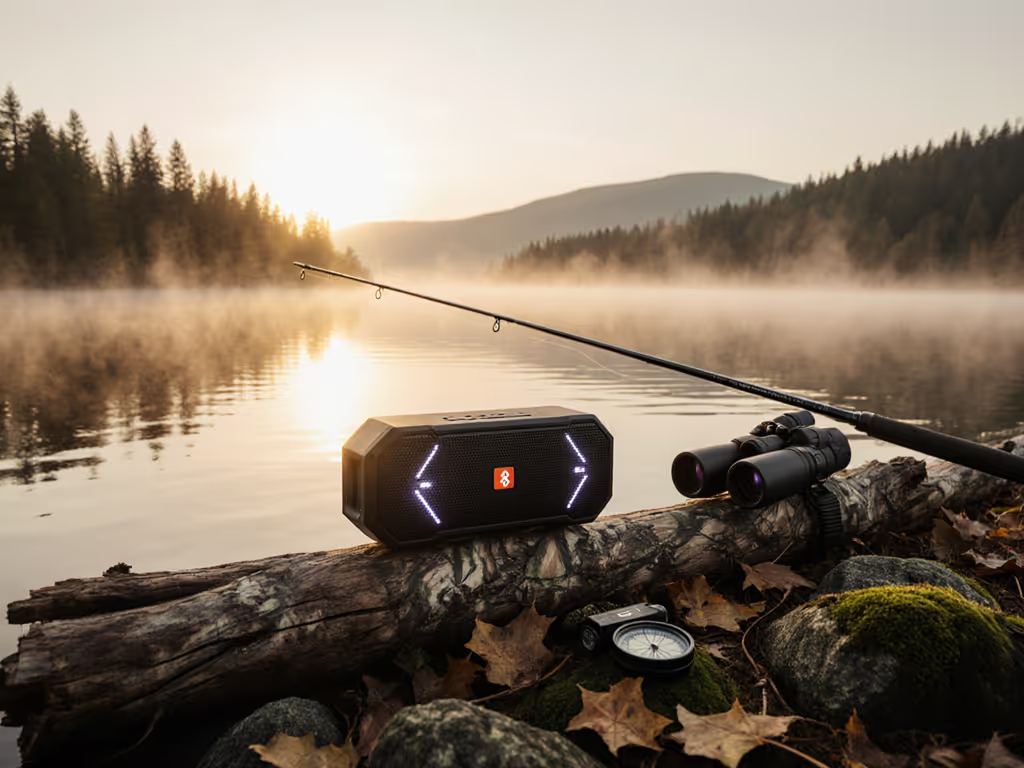
You don't buy the best bluetooth outdoor speakers for hunting and fishing to win a backyard beauty contest, you buy them to work, quietly and predictably, in places where reception is patchy, weather shifts fast, and spooking game or blowing out a dawn bite is a real risk. Think of them as fishing trip audio systems and low-profile camp companions, not party cannons.
Why Hunting & Fishing Speakers Are Different
Most Bluetooth speaker reviews assume patios, hotel rooms, or pool decks. For rugged, field-tested options beyond patios, see our outdoor speaker picks. Out in the field, the priorities shift:
- You often want background sound, not a soundstage that carries across a valley.
- Wildlife disturbance prevention matters: the wrong volume or direction risks pushing birds off a marsh or fish out of the shallows.
- Remote area connectivity is less about Wi-Fi apps and more about a stable Bluetooth link to a phone stashed in a dry bag or chest pocket.
- Ruggedness and runtime outrank fancy DSP tricks. A dead or waterlogged speaker halfway through the weekend is dead weight.
I've ridden out enough surprise storms with multiple speakers running side-by-side to trust one rule above all: if a speaker can't serve the whole scenario without surprises, it fails.
Field Priorities: What Actually Matters
1. Loudness and Control (dB at 1 m and 5 m)
Outside, there are no walls to help you. A speaker that sounds big in a bedroom can disappear on an open bank.
For reference, measured at 1 m in front of the speaker:
-
Tree stand / blind / still-hunting
-
Target: 65-72 dB at 1 m (conversational to slightly loud speech)
-
Goal: You hear music or a podcast clearly; 20-30 m away it's barely noticeable.
-
Shore or dock fishing, small jon boat, kayak
-
Target: 72-78 dB at 1 m
-
Enough to cut through wind and lapping water, still modest footprint.
-
Base camp at truck / cabin patio
-
Target: 80-86 dB at 1 m
-
This is where a larger unit or stereo pair makes sense.
At 5 m, expect roughly -6 to -10 dB compared to 1 m, depending on speaker pattern and wind. I grade speakers by whether they can hold their tone and clarity at those 5 m readings without obvious strain.
If you plan to hunt with others, look for speakers that stay clean and clear at 65-75 dB, not just "loud." If you're mostly fishing on a boat, you can push toward 80 dB at 1 m, but favor units that don't hard-compress bass when you nudge the volume up.
2. Battery and Survivability-Hours
Manufacturer "24-hour" claims are often at low volumes indoors. I care about runtime at real outdoor loudness, then map that to scenarios as survivability-hours (how long the speaker can play your actual use pattern before becoming a liability).
For field use, aim for:
-
Day-hunt, light fishing (4-6 h play)
-
Minimum: 8 h rated battery
-
Survivability target: 1.5× your longest day, so it still has reserve in cold weather.
-
Full-day float or bank session (8-10 h play)
-
Minimum: 12-15 h rated at moderate volume
-
Weekend trip (both days + camp)
-
Minimum: 20+ h rated or USB-C fast charge plus a known-good power bank.
Cold knocks capacity down; so does running near max volume. I down-rate any claim by 30-40% when I compute survivability-hours for real trips. To stretch runtime on real trips, use these battery life optimization tips.
Survive the weekend, then impress.
If you can't reasonably cover your whole trip with 20-30% reserve, the design isn't ready for remote use.
3. Ruggedness and Weatherproofing
If it can't shrug off rain, it's not ready to go.
For hunting and fishing, IP ratings matter more than fabric weaves or colorways. If you need a refresher on what IP67 vs IPX7 actually protects against, read our IPX ratings comparison.
-
IP67 - Dust-tight, and tested for submersion up to 1 m for 30 minutes.
-
Good baseline for boat decks, riverbanks, and muddy blinds.
-
IP66 - Dust-tight, protected against powerful water jets.
-
Fine for heavy rain and wash-downs, but not a drop in the lake.
-
IPX7 - Submersion-rated but no dust rating.
-
Okay on water, less ideal for sandy riverbars or dusty trails.
Hunting in mud or sand? I strongly favor IP67 with protected ports and a single, gasketed USB-C flap. Fishing around saltwater? Add corrosion resistance and easy-to-rinse surfaces to the list (simple shapes, no fabric that soaks and crusts). Boaters should also check our marine speaker guide for salt-resistant picks and mounting ideas.
4. Remote Area Connectivity
Out where you actually want to be, you probably won't have Wi-Fi, so ignore multi-room app ecosystems.
Focus on:
- Bluetooth version 5.0 or newer - more efficient and more stable range.
- Real-world range through your body and a jacket: I check whether a speaker stays solid with my phone in a zipped pocket at 5-8 m.
- Controls on-device that don't require an app, so you can leave the phone sealed in a dry bag.
For river and lake trips, treat the phone as a local file player (download playlists, podcasts, maps) and the speaker as a dumb, reliable endpoint.
5. Form Factor, Mounting, and "Tactical" Profiles
"Tactical audio speakers" in this context aren't about camo prints, they're about staying out of the way:
-
Low-profile hunting speakers
-
Small, flat, or cylindrical units under 500 g, with a lanyard or clip.
-
Dark, non-reflective surfaces; minimal LEDs or configurable stealth mode.
-
Boat and bank fishing speakers
-
Slightly larger, with stable bases or rail mounts, and lanyard points.
-
Designs that don't roll off a gunnel when a wave hits.
Controls should be glove-friendly, with separate volume and playback buttons and no blaring startup tones that announce your arrival to the whole marsh.
Scenario Breakdown: Matching Speakers to Real Hunts and Trips
Here's how I map the field needs before I even look at models.
| Scenario | Recommended loudness (1 m) | Minimum real-world battery (at moderate volume) | Target IP rating | Form factor priority | Wildlife disturbance risk |
|---|---|---|---|---|---|
| Tree stand / ground blind | 65-72 dB | 6-8 h | IP67 | Ultra-compact, low-profile | High |
| Spot-and-stalk / still-hunting | 60-68 dB | 4-6 h | IP67 | Pocketable, very quiet controls | Very high |
| Shore / dock / bank fishing | 72-78 dB | 8-10 h | IP67 or IPX7 | Small to mid, stable base | Medium |
| Small boat / kayak | 75-80 dB | 10-12 h | IP67 or IP66 | Strap or mount-friendly | Medium |
| Truck tailgate / base camp / cabin | 80-86 dB | 12-20 h | IP66+ | Mid-large, may run in stereo | Low (away from game) |
| Ice fishing shelter / shanty | 68-75 dB | 10-12 h (cold) | IP67 | Compact, works in cold, non-slip | Low-medium |
Tree Stand and Blind Use
Here, stealth is king. You don't want a speaker that chirps and whoops every time it powers on or reconnects.
Look for:
- IP67 micro-speaker with a single, rubberized strap.
- Physical volume buttons you can feather up or down without looking.
- A way to disable voice prompts and LEDs.
Set it around 65 dB at 1 m, tucked near your pack rather than on the rail. Podcasts and ambient tracks at that level are audible to you but attenuate sharply within 20-30 m.
Bank, Dock, and Pier Fishing
Wind, waves, and chatter make these "moderate noise" environments.
Good matches:
- Small to mid-size cylinders or bricks with dual drivers and passive radiators.
- IP67 or IPX7 so an unexpected slip off the dock is survivable.
- Bottom grips or feet so it doesn't skate when the deck's wet.
Aim for 72-78 dB at 1 m; at 5 m you'll still hear your audio clearly while others on the pier just catch a hint.
Kayaks, Canoes, and Small Boats
Here, your speaker might see:
- Direct spray, occasional dunkings, and lots of UV.
- You shifting position, casting, stowing paddles.
Key features:
- IP67 minimum, with absolutely sealed ports.
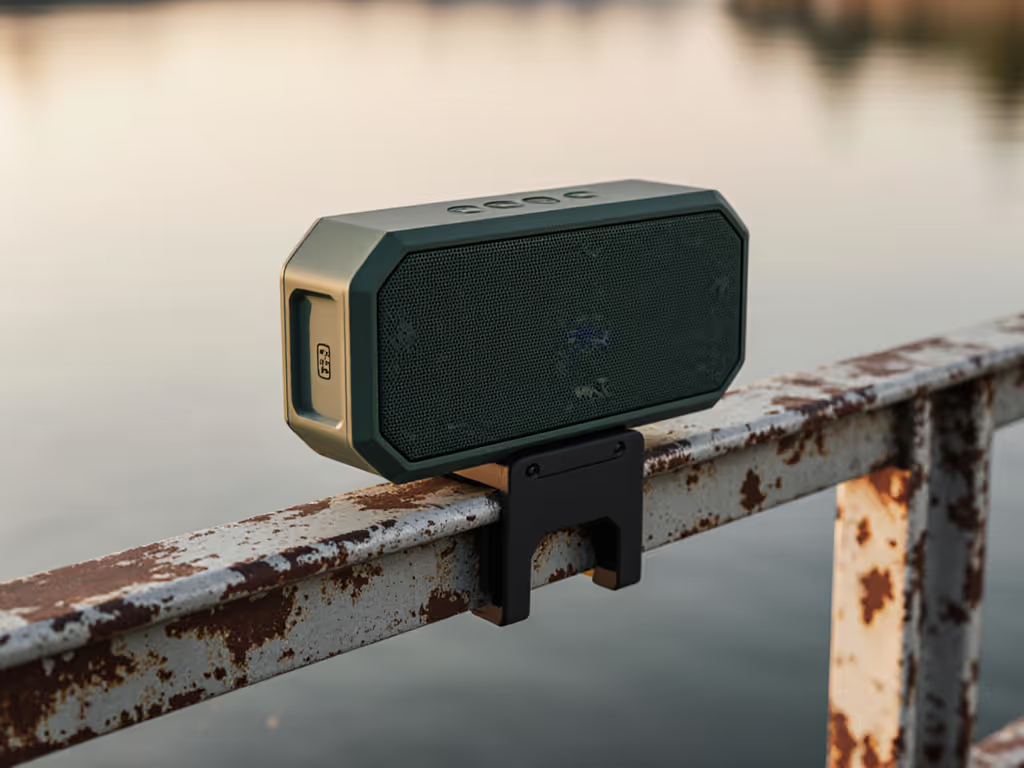
- Secure mounting options: tie-down loops, carabiner points, or rail clamps.
- A battery that can comfortably run 10-12 h at mid volume, or fast USB-C top-ups from a power bank.
Volume-wise, 75-80 dB at 1 m covers wind and motor noise on smaller rigs without broadcasting across the whole bay.
Base Camp and Cabin Duty
This is where you can step up in size and output without worrying about spooking anything.
Your priorities flip a bit:
- Strong battery endurance (12-20 h at moderate volume) for evenings.
- Broad sound dispersion so a few people around the fire get even coverage.
- Maybe stereo pairing of two matching units, but only if you've confirmed the brand actually keeps the link stable. Before you buy two, review our Bluetooth stereo pairing guide for brand-by-brand compatibility tips.
Out here I don't mind speakers that hit 80-86 dB at 1 m, provided they stay clean and don't sag in bass after a few hours.
Example Setups: From Minimalist to Full Weekend Rig
1. Minimalist Hunter's Kit
Profile: Solo or duo hunts, tree stands and blinds, plus occasional short bank fishing.
- Speaker type: IP67 micro or small speaker, <400 g.
- Loudness target: Up to 70-72 dB at 1 m without distortion.
- Battery target: Rated 10-12 h, used 4-6 h/day with 30% reserve.
- Extras: Lanyard, low-profile color, user-selectable "silent" mode for prompts.
Usage pattern: Podcasts and low-volume music during slow stretches, then full silence when animals are likely to move. The speaker lives clipped inside the pack or near the seat, never on a visible branch.
2. Fishing-Focused "All-Day Water" Setup
Profile: Long bank sessions, small boats, kayaks, sometimes into dusk.
- Speaker type: Mid-size IP67 or IP66 unit, 500-900 g, stable base.
- Loudness target: Clean 78-80 dB at 1 m; 68-72 dB at 5 m.
- Battery target: Rated 15-20 h, realistic 10-12 h continuous.
- Extras: Strong tie-down options, clear battery indicator, USB-C fast charging.
Patterns: Moderate volume most of the day, short louder bursts when motors or wind pick up. The speaker gets knocked, splashed, and occasionally left on a hot deck. Simpler shapes fight fewer tangles with rods and net handles.
3. Weekend Hunting + Fishing + Camp Combo
Profile: Drive-to spot with mix of still-hunting, day hikes, and evenings around the truck or cabin.
- Speaker type: One small tactical unit for the field, plus one mid-size or larger for camp.
- Field unit: As in the minimalist kit - quiet, compact, conservatively loud.
- Camp unit: IP66+ with 20+ h rated battery, 80+ dB at 1 m, more bass.
Here, separation solves the core trade-off: your field speaker stays discreet and low-risk; your camp speaker can be brighter, louder, and easier to control in gloves. I've watched storms roll in on trips like this with three speakers running identical tracks, timers ticking. By sunrise, the only ones I trusted again were the ones that still played cleanly after a waist-height (around 1 m) drop on wet gravel.
Buying Checklist: Turn Specs Into Field Confidence
When you're comparing candidates and marketing copy all looks the same, run this list:
- IP rating
- Minimum IP67 for true hunting/fishing duty.
- Reject anything that's just "water-resistant" with no clear rating.
- Battery vs. your itinerary
- Note your longest likely play window per day.
- Multiply by 1.5× for survivability-hours.
- Cross off any speaker whose realistic battery falls short of that.
- Measured or reviewed loudness at 1 m
- For hunting: prioritize quality and control around 65-72 dB.
- For fishing: ensure the unit still sounds composed at 75-80 dB.
- Controls and prompts
- Can you disable voice prompts and loud beeps?
- Are buttons distinct and glove-friendly?
- Mounting / carry
- Does it have solid loops or strap points for blinds, packs, or boats?
- Non-slip base for boards, docks, and truck beds?
- Connectivity behavior
- Bluetooth 5.x or newer.
- Wakes and reconnects reliably without blasting a startup tune.
- Weight and footprint
- Ask yourself: Would I still take this if I had to carry it for 10 km?
- For true backcountry hunts, err small; for truck-based trips, you can go larger.
When a speaker passes this checklist, chances are it will quietly earn its place in your pack or boat instead of riding the gear bin.
Final Verdict: Best Bluetooth Outdoor Speakers by Use-Case
In the hunting and fishing world, "best" is scenario-specific, not brand-specific. To cut decision fatigue:
-
Mostly hunting, some short fishing
-
Your best choice is a low-profile, IP67 micro-speaker that tops out around 70 dB and runs a conservative 6-8 h at that level.
-
Wildlife disturbance prevention and stealth take priority over bass or party tricks.
-
Mostly bank/boat fishing, casual campfires
-
Go for a mid-size IP67/66 unit with stable footing, clear battery readout, and 80 dB headroom for windy sections.
-
Treat it as your main fishing trip audio system, keeping volume modest when near other anglers.
-
Mixed hunting + fishing weekends with full camps
-
Pair a small tactical audio speaker for the field with a larger camp-focused speaker that can comfortably run evenings at moderate volume.
-
This split lets you stay discreet when it matters and relaxed when it doesn't.
If you filter options with those use-cases and numbers in mind (loudness at 1 m and 5 m, survivability-hours, IP rating, and form factor), you'll end up with a speaker that feels boringly predictable in the best way. Out there, that's the real luxury: gear that simply works, all weekend, without surprises.